Showing posts with label Eric Rohmer. Show all posts

Sunday, May 21, 2017

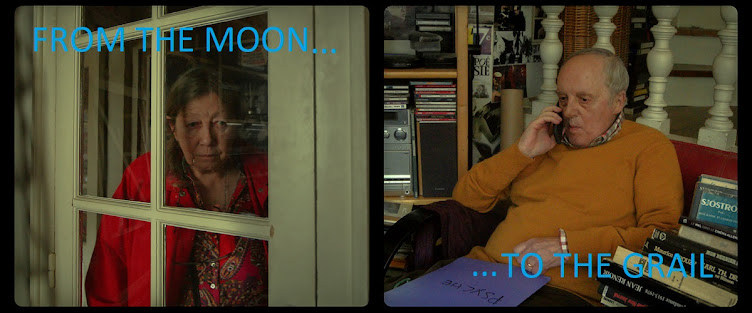
SINS OF OMISSION - Entry #65: Les nuits de la pleine lune/Full Moon in Paris (1984)


Running Time: 100 minutes
Directed By: Eric Rohmer
Written By: Eric Rohmer
Main Cast: Pascale Ogier, Tcheky Karyo, Fabrice Luchini, Virgine Thevenet, Christian Vadim
Click here to view the trailer

ROHMER CONTINUES TO IMPRESS, MAKES IT FIVE

I have really come to love Eric Rohmer and I can thank THE BOOK for that - where I was introduced to the director with My Night at Maud's. Since then I've slowly been rationing to myself the rest of his catalog, never watching more than one at a time and never too close together. I like to take his movies like a plant takes Miracle Gro - a scoop or so every other month. His films are simple, subtle, beautiful, sometimes heartbreaking, thought provoking and usually great. Full Moon in Paris is no exception.

Full Moon in Paris joins My Night at Maud's, Love in the Afternoon, Pauline at the Beach and A Tale of Winter to make it five for Rohmer on my personal 1000 list.


RATING: 8.5/10

Tuesday, May 15, 2012

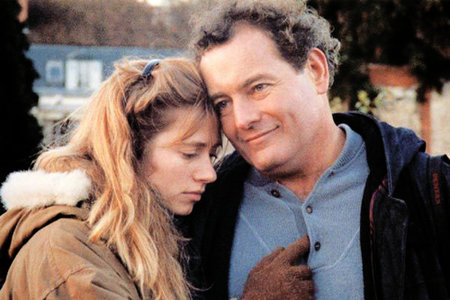
850. Conte d'hiver/A Tale of Winter (1992)


Running Time: 114 minutes
Directed By: Eric Rohmer
Written By: Eric Rohmer
Main Cast: Charlotte Very, Frederic van den Driessche, Michel Voletti, Herve Furic, Ava Loraschi
Click here to view the trailer

IT CAME FROM YOUTUBE

Last night, I began another search on YouTube for some of the films that still grace my "unfound" list (a list of films from THE BOOK that I still can't find, which currently sits at, at least, one hundred strong) and came upon "A Tale of Winter", directed by Eric Rohmer. I decided to give it a watch before it disappeared.

The film begins with a beautiful score, accompanying a montage of scenes of a couple enjoying time together at the beach, making love and being in love. When the montage comes to an end, we see the couple saying their goodbyes to one another, Felicie (Very) going back to Paris and Charles (van den Driessche) off to work as a chef in a restaurant. Felicie gives Charles her address and he promises to write. Fast forward five years later and Felicie is still in Paris, now with a daughter, Elise (Loraschi), working as a stylist in Maxence's Salon. Elise belongs to Charles but he doesn't know she exists and due to Felicie giving Charles the wrong address - a slip of the tongue - she hasn't seen him since they departed. However, her heart still belongs to him and she yearns for the day that they'll reunite and her family will be complete. She keeps Charles' picture in her Elise's room, so that she recognizes her father. Meanwhile, Felicie is living with her mother and holding down two suitors: Maxence (Voletti) of Maxence's Salon and Loic (Furic), a religious, philosophical librarian. At first, she decides that she'll move to Nevers with Maxence, where he'll open up a new salon and she'll be the boss. The two, along with Elise, go to Nevers, but after a day Felicie decides that she's made a mistake and briskly returns to Paris. She returns to Loic, who seems to love Felicie and in fact, seems to love her so much that he puts up with her ever changing mind and her head games. Felicie really doesn't know what she wants with her current suitors, whether she wants to be friends or lovers. What she does know is that she wants Charles to return to her.

Felicie and Charles
At times, "A Tale of Winter" reminded me of "My Night at Maud's", a movie that I watched last 100 and one that made the cut of my last TOP 20 list. It involved people, their relationships and the topics discussed amongst the characters often reached religious and philosophical bounds. However, in "A Tale of Winter" the characters, most notably the main character of Felicie, wasn't an intelligent one. In fact, she came off as quite dumb and at times, I had a hard time sympathizing with her. She seemed to lack both book sense and common sense and was such a confused woman, that her confusion was almost maddening to this viewer. In fact, the character that I sympathized with the most was Loic. He seemed to be the one that got the most heartache out of the whole situation, being there for Felicie at her beckon call and being promptly tossed into the gutter by her not once, but twice. He was the type of guy who was always going to return to Felicie no matter how many times she walked all over him and she was never going to give her heart to him. He was just her "go to guy", her shoulder to cry on. Maxence had more of a rugged personality and even though Felicie treated him the same way, he came off as kind of a jerk, so I didn't feel as sorry for him.

Felicie and Loic
SPOILER ALERT!

I can't say I was all that pleased with the ending either. Like I said, the character of Felicie wasn't one that I sympathized with in the least, so to see her get Charles back in the end wasn't necessarily a happy ending for me. It's not that I didn't see Charles' return coming, it's just that I wish it had been executed differently and I wish Rohmer had made the character of Felicie more sympathetic. Why would we, the viewer, want to see her get her way after the way she treated her other lovers? Am I wrong or did the whole ending hinge on Felicie's faith and perhaps the prayer that Loic gave when Felicie forced him to go to mass, Felicie asking him to pray as if he were her and ask for what she'd want, even if it would hurt him. Perhaps Loic was a man of strong faith and perhaps he asked for Charles' return, so that Felicie could be happy. In fact, perhaps the ending isn't so happy. Perhaps Loic was the man for Felicie, but she couldn't see it because she was so fixed on someday finding Charles that she was never going to settle for anyone else. Felicie was blinded by her crush, a man she only spent a vacation with and she wasn't bright enough to forget her crush, open her eyes and see that true love was already there, in the form of Loic.

Felicie and Maxence
Anyway, I did enjoy the movie. With each French film I see, I warm up to them more and more. I think that French filmmaker's excel on so many levels, including dialogue, character development, mood and atmosphere. Their plots aren't always as gripping as they could be, but I've learned throughout my journey that there are more important things. "A Tale of Winter" has interesting characters, interesting situations and does a fine job of showing off the French landscapes. It provided this viewer with some gripping dialogue, that, unlike "My Night at Maud's", didn't often go over my head. Rohmer is quickly becoming a favorite of mine and I can't wait to someday check out the rest of his catalog. In fact, I wish the other three installments of his Tales of the Four Seasons were included in THE BOOK, so that I could watch them right away and compare them. As it is, however, they'll have to wait until I get some free time.

RATING: 8/10  It had '10' potential, but didn't quite get there. By the way, expect about five more of these "It Came from YouTube" posts before I wrap up this 100.

MOVIES WATCHED: 453
MOVIES LEFT TO WATCH: 548

May 15, 2012  2:12am

Thursday, November 17, 2011

492. Ma nuit chez Maud/My Night at Maud's (1969)

Running Time: 110 minutes
Directed By: Eric Rohmer
Written By: Eric Rohmer
Main Cast: Jean-Louis Trintignant, Francoise Fabian, Marie-Christine Barrault, Antoine Vitez
Click here to view the trailer

A MORAL TALE

In fact, there were six "moral tales" directed by Eric Rohmer, but "My Night at Maud's" happens to be the only one included in THE BOOK. It's a shame really, because this film really peaked my interest in Eric Rohmer and makes me excited to discover more of his hidden gems, of which there's bound to be many.

Jean-Louis (Trintignant) is a Catholic, living in Clermont in France. He is new to the area, working as an engineer and spends his free time studying mathematics and keeping to himself. He attends Sunday services and is enamored by a cute, young blonde whom he sees there every Sunday, but has never mustered up the courage to approach. One day, Jean-Louis runs into an old friend, Vidal (Vitez), whom he hasn't seen in fourteen years. It is just after Christmas, but before New Year's and the two old chums sip beverages at a coffee bar and talk as if they've never missed a beat. At the end of their conversation, Vidal persuades Jean-Louis to join him in visiting a lady friend of his, Maud (Fabian). Jean-Louis reluctantly agrees. The evening between Jean-Louis, Vidal and Maud and their conversations, ranging from religion to love to philosophy, takes up a major part of the film. Eventually Vidal has too much too drink and excuses himself, leaving Jean-Louis and Maud alone together. When Maud persuades Jean-Louis to spend the night, so he won't have to drive in the snow, Jean-Louis is faced with some difficult decisions of morality.

SPOILER ALERT!

I kind of have to argue whether or not this is really a "moral tale". In my opinion, "My Night at Maud's" was not so much a tale of morality, but rather a tale of the decisions we make and the finality of those decisions. It also speaks volumes on the relationships that we kindle as human beings and how sometimes, so easily, they get extinguished. Let's take the main character of Jean-Louis and dissect him. For starters, he was a very complex character. He touted devout Catholicism, yet he had a very repugnant demeanor, at times. During the conversation scene, between Jean-Louis, Maud and Vidal, he seemed so cocky and smug and not the type of person you'd expect to be harping on about religion and morality. As the film goes on he becomes more relateable, but we'll get into that in a second. Here you had a guy who seemed to have his entire life thought out. He somehow knew that he was going to marry the mystery woman from the church, he knew that he wanted a Catholic girl, if nothing else and he often times, throughout the film, claimed that "he knew he wasn't wrong" or "i know I'm right". For him, everything was so final and his life seemed to depend on these solid, structural choices he'd made for himself.

So then you get to the point of the film that actually makes this a "moral tale" and the scene where Jean-Louis is confronted with the beautiful Maud, as they lie in bed together - her nude and him wrapped in a blanket and trying hard to stick to his guns. And, what do you know, Jean-Louis sticks to his guns and when the carrot is dangled in front of him, so to speak, he doesn't go for it. He resists. BUT...he still feels guilty about it. To me, that's fascinating and rings true to life. The reason I say he still feels guilty about it, is at the end of the film, immediately after he runs into Maud at the beach, he's tripping over his own tongue, trying to explain everything to Francoise, who is now his wife. He still feels like he has to explain her, as if she actually is an old lover of his, when in reality, nothing happened between them. They DID have a very deep bond, as short as it lasted, but sexually - nothing happened.

And let's talk about that bond between Jean-Louis and Maud for a moment, shall we. I think we all have people in our lives that we've happened upon, spent a very short amount of time with and then parted ways with, never to see them again. It's so sad really. In the film, when Maud and Jean-Louis are in her apartment and they part and promise to phone one another, it was, to me, a very sad scene, because you kind of knew that they were just going to forget about one another. For me this really hit home, because I've had so many friendships in my life that have blown away like dust in the wind. It's truly heartbreaking if you stop and think about it. You meet someone and for the time that you know them, they're special people to you, but then they go away, for one reason or another and soon they're nothing to you. To go from something to nothing is just heartbreaking. It was also very interesting how Francoise, at first, was completely uninterested in Jean-Louis, yet he was enamored with her. Maud, on the other hand, all but threw herself at Jean-Louis, yet he had already made up his mind that Francoise was the girl for him. It's something that I can't fully understand, yet am fascinated by and can understand on some levels.

As for the bad, I'm not sure I could really relate to the subject matter that existed in the dialogue. I'm just not the type of guy who enjoys sitting around talking about religion, Blaise Pascal and destiny. They're conversations, at times, made me feel like a child in a room full of adults. Not that they made me feel inferior or unintelligent, just that they made me feel bored and uninterested. I was more thought provoked by the actions of the actors and the ultimate outcomes, than the dialogue. However, the dialogue was such a major part of the film, that it was hard to simply overlook it and concentrate on the big picture. I'm not so sure that the subject matter within the dialogue was very important though. I think as long as you were able to grasp the overall message and themes of the picture, you were just fine.

RATING: 7.5/10 I'm not really sure what to make of this one, at this time. I know that I admire how much it made me think and that I think I'm going to be tossing it around in my head for many weeks to come.

MOVIES WATCHED: 349
MOVIES LEFT TO WATCH:
652

November 17, 2011 2:45am

Sins of Omission - Entry #94: ZODIAC (2007)

Running Time: 157 minutes Directed By: David Fincher  Written By: James Vanderbilt, based on the book by Robert Graysmith Main Cast : Jake...