Saturday, April 20, 2013

875. Pulp Fiction (1994)


Running Time: 154 minutes
Directed By: Quentin Tarantino
Written By: Quentin Tarantino, Roger Avary
Main Cast: John Travolta, Samuel L. Jackson, Bruce Willis, Uma Thurman, Harvey Keitel
Click here to view the trailer

MY FAVORITE FILM AND DJANGO TALK

So, here's the deal: "Pulp Fiction" was SUPPOSED to be the film that I ended my entire journey with, the 1001th review that I would have written. The reason it was going to be the final film, is because it has long since been the movie that I cite whenever someone asks me what my favorite movie is and I figured what better way to end, than with my stock answer to the favorite film query. HOWEVER, after watching "Django Unchained" the other night, I had a mean hankering to do some comparing - comparing between the Quentin Tarantino of 1994 and the Quentin Tarantino of 2012. It's an eighteen year difference and somewhere in there, he's gone from being my absolutely favorite director to being someone who always leaves me looking for just a little bit more and unfortunately, disappointing me often. Therefore, this review will be a little bit different than all of my other reviews, as I'll spend time talking about both "Pulp Fiction" and "Django Unchained" and doing some compare & contrast work. Off we go...

First, we get to the movie at hand: "Pulp Fiction". The film is split into a few different stories and it all starts with a couple common crooks (man and wife) sitting in a little diner, planning to rob the place when they're finished with their breakfast. Then we cut to a car and meet Jules (Jackson) and Vincent (Travolta), two hitmen, working for crime lord Marcellus Wallace and out on a job, just before 7:30am. As they get to where they're going, Vincent confides to Jules that, since Marcellus is going to be out of town the following day, he's asked Vincent to take care of his wife - take her out to dinner, show her a nice time, etc. Eventually the guys get to where they're going: an apartment and inside are three (four?) men, one of whom is undercover and working for Marcellus as well. The guys are after a briefcase and after they retrieve it, they kill the occupants of the apartment and are on their merry way. After this, we get a title card entitled "Vincent Vega and Marcellus Wallace's Wife" and we get that whole story. They go to dinner, casually flirt and dance at Jack Rabbit Slims (the restaurant). I won't give away anymore than that. From there, we go to "The Gold Watch", which tells the story of Butch Coolidge (Willis), a boxer who has been paid by Marcellus Wallace to throw his upcoming fight (we saw the payoff earlier, after the briefcase piece). Butch takes, seemingly a lot of money, but come fight time wins the fight and actually kills his opponent. He flees the arena, heads to a hotel, meets up with his fiance, Fabienne, with plans to leave the following morning. Only one problem - she forgot to pack his gold watch, an heirloom, which has been handed down, starting with his great grandfather. Now, with dozens of hitmen and criminals looking for him, he must go back to his apartment to retrieve the watch. We end with a funny little piece entitled "The Bonnie Situation", which involves a man's head being blown off...but that's just the beginning.


Okay, so before we get into talking about "Django Unchained', let me first talk about why I love "Pulp Fiction". You know, I actually still remember watching "Pulp Fiction" for the first time. My brother and I had watched "Reservoir Dogs". I was young, but lucky enough to have a cool older brother who showed me quality films at my young age. At the time, he had seen both "Reservoir Dogs" and "Pulp Fiction" and when the former ended and I loved it as much as I did, he promised to get "Pulp Fiction" and show me that as well, with promises that most preferred it to "Dogs". We started watching it and after a little while, I decided that it wasn't for me and quit on it. Yep, that was my first encounter with "Pulp Fiction" - a bailed out viewing. The next day, something was eating at me. I needed to finish that movie and I really didn't know why, but I just knew if I could get all the way through it, I'd love it. There was something about those opening minutes (during the bail out viewing, I probably didn't even get to the introduction of Mia Wallace) that sparked something in me. So, I put it back in (it was a rental VHS) and sitting by myself, I finished it. I think, at first, it may have even had something to do with wanting to impress my brother. "Hey, I finished Pulp Fiction and I loved it", was something that, perhaps, I wanted to be able to say. Well I did love it and over the years, through MULTIPLE viewings (probably close to fifty, at least), it's always been a movie that just totally encapsulates me.

It's like saying water is wet and heat is hot, to say that the dialogue in "Pulp Fiction" is magnificent. Everyone who has seen it and liked it cites those exact words, so I won't hammer that point home. But it's more than just the dialogue. It's the way these stories are made to hook us and that, my God, there's three of them!! Maybe it's the fact that each story isn't copy & paste, cookie cutter material and that any of the three stories potentially had dozens of different outcomes. Would Mia have cheated on Marcellus with Vincent had she not overdosed? What if Butch hadn't gone back to save Marcellus? What if Bonnie had made it home? And, sonofabitch, what's in that briefcase!!?? Tarantino keeps us on our toes. He hooks us with the common criminals, continues hooking us and makes us laugh a little with the "Royale with Cheese" dialogue, warms us up with the Mia Wallace story, keeps the heat on for the Butch Coolidge story, lets us breathe a little bit and laugh with the Bonnie Situation and finally, has the criminals, that we've probably forgotten about at this point, reemerge and meet our two main characters. It's a ride man and let me tell you, it's a lot of fun and it's just so damn good. With this film, in 1994, Tarantino proved that he was the next link in the great director's chain and that if he stuck around, he'd become a force to be reckoned with on the filmmaking scene.

---


Fast forward to 2012 and notice that Tarantino did, indeed, stick around. He's now made seven feature films (eight if you count Kill Bill as two) over the course of a twenty year period, proving that meticulous work goes into the making of each of his films and that he's not just making movies for the sake of making movies. So why didn't I like "Django Unchained" near as much as anything pre "Kill Bill" (including "Kill Bill")? In fact, why didn't I like "Death Proof" or "Inglorious Basterds" as much either? Simple. Because Quentin Tarantino is getting older and because Quentin Tarantino has officially established himself. Look at his work...

Reservoir Dogs - This is Tarantino writing as a fan of film, after jockeying the register at a video store. He's still a bonafide fan and therefore he knows what other film fans want to see. Plus, he's a nobody when he writes this, so he's trying to get his foot in the door.

Pulp Fiction - Foot is in the door! Still a fan, still knows what we wanna see and hear, creating over the top characters, having conversations that could only possibly exist in the realm of a fictional work.

Jackie Brown - His first (and only) adaptation. He's stepping up in the world, but he's still got those independent roots and still knows how to tell an intriguing story, using out of sync chronology and different angles of the same scenes to his advantage.

Kill Bill - The turning point. The last movie he truly makes for his fans and he sends us off in style, breaking this epic into two parts and giving us two chances to say goodbye to the Tarantino of old. QT has always been a self indulgent filmmaker, but after this he'll be fully indulging; a little "me time" if you will.

Death Proof - Just messing around, as far as I can tell. The transition period between Kill Bill (the fans movie) and Inglorious Basterds (his movie).

Inglorious Basterds - A truly, 100% self-indulgent masterpiece. Good, but not near as good as anything pre "Kill Bill". Huge, overblown hat tip to Sergio Leone and now he's officially going into business for himself. He's no longer a fan, he's a celebrity and he knows this now, without a doubt. This is why QT is starting to lose me.

Django Unchained - Better than "Inglorious", but only by chance, because he's still in business for himself, still knows he's a celebrity and is still giving Sergio Leone onscreen blowjobs about every 10 - 12 minutes. Sorry to be so crass...


Hey, I liked "Django", don't get me wrong. However, it's sad seeing those traces of the old QT and realizing that he's probably never going to make a better film that "Pulp Fiction" or "Kill Bill" ever again. Just look at the way Leonardo DiCaprio's character talks; "tasty refreshment", for example. It's like a tip of the hat to himself, except it comes off as something like ripping himself off. Also, while ALL of QT's movies have had traces of comedy (hell, QT himself considers "Pulp Fiction" to be a full blown comedy, once citing in an interview that it should be in the comedy section of video stores), has there ever been a more blatant example of comedy that the KKK scene in "Django", with the crooked eye holes in their hoods? That was just stomach turning and God, even Jonah fucking Hill was in there!! Give me a break! If only QT could become a full blown fan again, forget his celebrity or even get a bad review, then maybe that would be enough to knock him off his pedestal and push him to get back some of that originality. However, even if that doesn't happen, it is the opinion of this blogger that when Tarantino passes on, retires, whatever, he'll leave behind a catalog of work that can hold water against the likes of the greatest director's of all-time. I may not like the extremely self-indulgent, post "Kill Bill" QT AS MUCH and he still may not be hitting home runs, but he's getting some nice double plays, nonetheless.

RATING: 10/10   And "Le Trou" officially has competition this season...and my God, picking between the two is going to be harder than Sophie's choice.

DJANGO RATING: 7.5/10  Good score, but for QT it's still a disappointment. He used to be my favorite director and anything below an '8' seemed impossible. Oh the times they are a changin'.

MOVIES WATCHED: 661
MOVIES LEFT TO WATCH: 340

April 20, 2013  10:22pm

Thursday, April 18, 2013

275. A Star Is Born (1954)


Running Time: 176 minutes
Directed By: George Cukor
Written By: Moss Hart, from the 1937 screenplay by Alan Campbell and Dorothy Parker, story by William A. Wellman
Main Cast: Judy Garland, James Mason, Jack Carson, Charles Bickford, Tommy Noonan
Click here to view the trailer

A DOUBLE SHOT OF CUKOR: 1 of 2

Having already watched four George Cukor movies (five, if you count "Gone With the Wind") and, at least, liking the majority of them, I decided to clean up the other two - two long ones - with a "Double Shot of Cukor", taking care of his two musicals - one from the 50s and one from the 60s. First up, "A Star Is Born".


Actually, in a way, the plot of "A Star Is Born" resembles the plot of recent Best Picture winner "The Artist". The film tells of the rise in fame of Esther Blodgett a.k.a. Vicki Lester (Garland), a virtual nobody, who is discovered by big time Hollywood star Norman Maine (Mason). During a Hollywood event, in which Maine shows up drunk, he is saved from embarrassment by Esther, as she manages to hold him up long enough to incorporate him into her dance number. Maine, feeling grateful for the saving of face by Esther, tracks her down and when he listens to her with a sober ear, realizes that much talent lies in her voice. Norman convinces Esther to leave the band that she's been traveling with and let him take over her career, promising to shoot her to super stardom or die trying. After a while, Norman follows through with his promises, getting Esther a contract at the studio that handles him and it isn't long before she's starring in her very own picture. Meanwhile, Norman's star is falling, as he continually turns to the bottle, allowing his career to be washed away by the alcohol that consumes him. However, Esther, even as her star continues to rise and she becomes the studio's hottest commodity, never forgets Norman and eventually they get married. Following the marriage, however, the studio decides to drop Norman's contract, citing that they can no longer babysit a drunkard. This only forces Norman even further into the bottle, as he is now jobless and losing large amounts of his pride by the day, living off of the celebrity of his wife.


There, that outta get you up to speed. Now, doesn't that sound awfully bleak for a movie musical? It does to me and by the end of the picture, every time they'd begin another musical number, I'd have to keep reminding myself, "Oh yeah, this IS a musical, isn't it?"  Usually Hollywood musicals, especially those of yesteryear, are so happy that they nearly start tickling your gag reflexes and it gets to be a little too jolly for one to stomach. Here the musical numbers are heavily overshadowed by the plot that is unfolding: a pretty good love story;  the fall of a Hollywood superstar, as he buries himself in the bottle and the rise in celebrity of a young girl. In fact, I'd go so far as to say that the music in "A Star Is Born" barely has a voice and by the time the picture finished, I could barely remember a single song from the movie. There are no memorable songs, only memorable choreography. For example, as I sit here, I can remember Judy Garland dancing around her living room, showing Norman her new number and the two actors looking like they were having a blast shooting it, however, I can't, for the life of me, remember the tune that Judy was singing. Forgettable music sacrificed for a strong plot and decent choreography is how I'd sum up "A Star Is Born".


I was more excited to watch this that I would've been had I not watched "Bigger Than Life" and fell instantly in love with James Mason's acting abilities. I actually couldn't wait for another chance to check out Mason in action and it's a shame that I didn't recognize him a little earlier in my journey, for I may have liked "The Reckless Moment", "Odd Man Out" and "Lolita" a little bit more. He was great here, playing a drunken falling star to near perfection. Judy Garland on the other hand didn't really impress me that much and more annoyed me than anything. I could've done with a more talented actress in her role, as I think the picture would've benefited greatly from that...but who am I to doubt Judy Garland? It wasn't a particularly great movie, but it certainly had it's moments. For being three hours in length, I thought it used it's time wisely and honestly, it barely felt like three hours had gone by. I won't stoop to spoiling anything here, but what finally happens to the Norman Maine character took my by total surprise - was not expecting that, at all. I liked how the film ended and all in all, I'd say that I liked the bleakness of the whole affair. Had the music been better and Judy Garland been replaced, I think we could've been looking at a serious TOP 20 contender.

RATING: 7/10  But, as it is, this is barely a Ten Worth Mentioning contender and that '7' is probably me being just a sliver too generous. We shall see...

MOVIES WATCHED: 660
MOVIES LEFT TO WATCH: 341

April 18, 2013  4:21pm

Wednesday, April 17, 2013

323. Gunfight at the O.K. Corral (1957)


Running Time: 122 minutes
Directed By: John Sturges
Written By: George Scullin, Leon Uris, from the article The Killer by George Scullin
Main Cast: Burt Lancaster, Kirk Douglas, Rhonda Fleming, Jo Van Fleet, John Ireland
Click here to view the trailer

A STEP IN THE RIGHT DIRECTION

Following a string of disappointing films (five to be exact), "Gunfight at the O.K. Corral" is a STEP in the right direction. Granted, I would've much preferred a leap in the right direction, but a step will just have to do.


I think we all know, at least us movie fanatics anyway, the story of Wyatt Earp and Doc Holliday, so a brief and succinct plot synopsis should do just fine here. This time around Burt Lancaster is Wyatt Earp, Marshall of Dodge City, who tries to run the town with a fair and firm hand. Kirk Douglas is Doc Holliday, a dentist turned gambler who ain't too bad with a gun, nor a knife. The film doesn't lack bad guys either, as we learn about Ike Clanton and Johnny Ringo (Ireland), the former of which wants to transport a herd of stolen cattle out of Tombstone, Arizona; the latter of which is his hired hand. There's also a little love story intertwined in all the action too, as Wyatt falls for female gambler Laura Denbow (Fleming). Just as he's about to give up his Marshal job and marry her, trouble in Tombstone beckons, as Wyatt's brothers call upon him to help them stop the Clanton gang. Throughout the film, the friendship between Holliday and Earp is cemented and when the time comes for Wyatt and family to go to war, The Earps have no choice but to call on the terminally ill Doc.


So here we have another above average, but less than stellar Kirk Douglas movie and my hunt for the perfect Douglas movie continues. I swear I love watching the guy, but none of his movies have really hit the spot (unless you count "Out of the Past", which is more Robert Mitchum's movie than his). Yes, that's right, "Gunfight at the O.K. Corral" just failed to really quench my thirst for a great movie and despite being a step in the right direction, it was still far from a flawless affair. For starters, I'd say that it was a little on the long side. Had they been able to trim about twenty minutes, or even better, a half hour, I think the movie would've rolled along a lot smoother. There's a big chunk in the middle (and I do mean a BIG chunk) where the action sort of lingers, as all the characters have been introduced, all the fuses have been lit and we're simply left to wait around until the fire reaches the dynamite. Of course, the dynamite is THE gunfight at the O.K. Corral, which is very well shot, but barely worth waiting for, as it speeds along too fast and only lasts about seven-eight minutes. They would've been more spot on to call the movie "The Adventures of Earp and Holliday", because that's really what the film is. The film focuses more on building their relationship and talking about all the little adventures they get into and all the bad guys they encounter and less on the actual events that lead to the big finale.


On a more positive note, I have absolutely no complaints with the cast, as Lancaster and Douglas were both very well cast, with Douglas being the real star of the show - for me anyway. Rhonda Fleming looked amazing and the rest of the supporting cast did a fine job...no complaints. It's not that the movie was bad or anything (like I said...a step in the right direction), I just didn't get that "must see" feeling from it. It was certainly watchable, followable and for the most part, enjoyable, but it really failed to hit that upper echelon of greatness that I like to see and that is becoming more rare this season. Thumbs in the middle for this blogger.

RATING: 6.5/10  Good, but not great. Speaking of "great", I really, really wish something GREAT would come along...please!

MOVIES WATCHED: 659
MOVIES LEFT TO WATCH: 342

April 17, 2013  1:56am

Tuesday, April 16, 2013

780. AKIRA (1988)


Running Time: 124 minutes
Directed By: Katsuhiro Otomo
Written By: Katsuhiro Otomo, Izo Hashimoto
Main Cast: (voices): Johnny Yong Bosch, Joshua Seth, Wendee Lee, James Lyon, Simon Isaacson
Click here to view the trailer

UMMM...NO

"Akira" had been sitting near the top of my Netflix queue for months, on a "Very Long Wait", until the other day, when it apparently became available and was shipped to me. Truth be told, I could've gone on waiting forever before I saw this travesty.


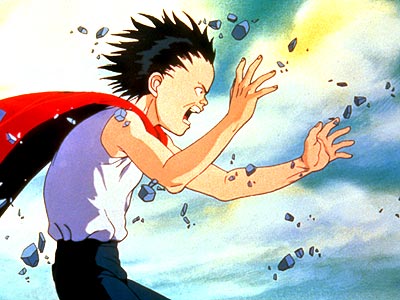
The film takes place in the year 2019, thirty-one years after World War III and the destruction of Tokyo. Now, in 2019, Neo-Tokyo is a booming city, but filled with crime and criminals, including several biker gangs. One of the biker gangs and our main characters, is led by Kaneda and he is followed by Tetsuo Shima. The film opens with a pretty well choreographed/animated biker gang fight, between Kaneda's gang and The Clowns, a rival gang. Later, once we're introduced to the characters and the setting of the city, we get into the thick of things, when a young boy is captured in Neo-Tokyo. The boy is Takashi and he possesses powerful psychic abilities and his captors are the government agency that did experimental testing on him and made him what he is. In the confusion of recapturing Takashi, Tetsuo is injured and is also captured by the government agency. For a while, Kaneda and fellow gangsters just assume that he's been taken to a hospital, but later learn that he's been captured by the agency and that they plan to do testing on Tetsuo as well. The testing leaves Tetsuo with even greater power than that of Takashi and actually powers that rival those of Akira's, the most powerful entity the agency has ever created and the reason for the destruction of Tokyo, so many years ago. When Tetsuo escapes his captors, a red alert is issued, as he and his powers reign over the city and Kaneda tries to get his friend back...


...at least I think that's what happened, but who really knows. I've got to be completely honest with you here, I pretty much checked out of this one at around the 45 minute - 1 hour mark, when I realized that this was repelling me 10x worse than Roberto Rossellini and his heavy-handed neorealism.  At that mark (45 minute - 1 hour) I fully realized that this was the exact opposite of what my cinematic palate desired and then I was just going through the motions; picking up what I could, trying my best to follow along and make it to THE END. Therefore, "Akira" was, without a doubt, ONE OF the worst experiences THE BOOK has put me through and what a shame that I've been saying that (or something like that) a lot lately, especially during a season that started out so promising. Why didn't I like "Akira"? Plain and simply, because it was everything I try to avoid in films. Let's back track a bit actually and I'll tell you that I was actually really looking forward to "Akira", because the idea of an animated feature geared toward adults appealed to me. I was ready to be blown away by the animators from Japan and ready to shower "Akira" with praise. The problem was that I just really didn't know what it was all about and once I realized that I was dealing with some serious science fiction, I did a complete 180 and was fully and utterly repelled. There are very few sci-fi movies that I can stand and even then there has to be other elements in play. Take "District 9" for instance, a science-fiction picture, that implements elements of survival and a love story...a success in my book. "Akira" was, however, a total failure: heavy sci-fi, government agencies, terrorism, mutating beings, robots, giant talking teddy bears...is not, in my opinion, what a good film makes.


I will give it points for being successful in the animation department, as I enjoyed that element. I will also give it points because, believe it or not, I can fully understand why THE BOOK included it. Obviously this was a big step in the field of Japanese anime and I am fully aware that there IS an audience for this kind of story and God bless you if you enjoy this, because you're far more tolerant than I. I am fully aware that THE BOOK wasn't tailor made to fit my personal tastes and obviously (as I know well by now) there are going to come films that completely revolt and repel me and that's okay. It only serves to add to my growing knowledge of all aspects of cinema. I'm happy that THE BOOK forced me to sit through "Akira" because, if nothing else, I can at least say that I've seen it and in the bigger picture, can say I've seen an anime film. It just wasn't for me in the slightest.

RATING: 2/10  A few points, but a '1' didn't seem fair and a '2.5' seemed too high, considering how much I hated every minute of this movie.

MOVIES WATCHED: 658
MOVIES LEFT TO WATCH: 343

April 16, 2013  9:54pm

Monday, April 15, 2013

265. Viaggio in Italia/Voyage in Italy (1953)


Running Time: 83 minutes
Directed By: Roberto Rossellini
Written By: Vitaliano Brancati, Roberto Rossellini
Main Cast: Ingrid Bergman, George Sanders, Maria Mauban, Anna Proclemer, Paul Muller

ROSSELLINI WEEK: THE CONCLUSION

In 657 movie reviews, this is the first one I almost forgot to write. I watched "Voyage in Italy" last night and intended to write the review when I got home from work today. Then, of course, came the news out of Boston, of the bombings and after being glued to the television for a little while, I fell asleep for an afternoon nap. Well, I'm wide awake now and it's time to wrap up "Rossellini Week".

NOTE: Speaking of the Boston situation, I'd like to take just a moment to send thoughts and prayers to everyone affected by today's events.


When the film begins, we meet the Joyce's - Katherine (Bergman) and Alex (Sanders) - as they're driving across Italy. You see, Alex's uncle has recently died and this English couple have come to Naples to sell a an inherited villa. Once they find the place and are given the grand tour, Alex expresses his desire to wrap up the trip as quick as possible. Being a workhorse (although I don't think it's ever said what he does exactly), he hopes to get home soon, so as not to let his work suffer. The Joyce's, once settled in, meet up with some old friends, by chance and Katherine gazes on with jealousy as Alex chats it up with a friend of a friend...a female, friend of a friend. As the day's progress, Katherine and Alex start to realize that they're just not right for one another any longer. Small tiffs lead to even bigger arguments and one thing leads to another and Alex decides to distance himself of the whole situation, by heading to neighboring Capri and spending a few days. Katherine takes the time to take in some of the sites of Pompei and Naples; visiting museums and even visiting Mt. Vesuvius. She's worried about Alex and the state of her marriage, but the audience can assume that even she'd admit, that with him gone her Italian vacation goes a lot smoother. Alex eventually returns and old problems resurface. Will the Joyce's make it out of Italy as man and wife, or will the knot come untied?


Seeing as how I nearly totally forgot to write this review and was headed to watch my next movie, I'm in movie watching mode and not movie writing mode, so I hope to wrap things up quickly, as it pertains to "Voyage in Italy". What started out as a perfectly acceptable premise - a ditch of the neorealism and talks of sainthood for Rossellini and fresh start, with a fresh movie and a fresh idea, turned sour pretty quick. Hey, I'm all for marriage in peril movies. I'm not sure why, but it's always been a topic that has intrigued me on film. Maybe because I have a perfect marriage and am astonished to watch movies about couples that don't. So, needless to say, I was ready for this one. I was hoping that this would be the movie that would bust Rossellini out of his slump and seemingly endless attack on my personal tastes. Well, I wasn't quite right. But, hey, it wasn't a total loss and it could've been worse...remember "Open City"?


Anyway, what started out as a marriage in peril movie, quickly turned into a "Vacationer's Guide to Traveling in Italy". Rossellini took advantage of some of the sites of Italy, more specifically Naples and therefore we get scenes with Ingrid Bergman touring museums and volcano sites. I'm not knocking the sites of Italy either, because I actually enjoyed seeing those statues and watching the smoke billow out of holes at the Vesuvius tour, but it took away from the real plot and that was a man and wife whose marriage was falling apart. THE BOOK is bold enough to compare "Voyage in Italy" to "Contempt", but this was barely half as good as that film. Like I said, not terrible, but it had the ability to dash even my slimmest of hopes. What should have been a film that was heavily dialogue driven, was actually a picture that relied more on visual aids and real life touring locations. I wish I could've wrapped "Rossellini Week" on a positive note, but sadly, I cannot.

RATING: 5.5/10  Better than average, but barely. And, by the way, while I did mention that Ingrid Bergman shined in "Europa '51", she didn't in this and really made me realize how much I dislike her as an actress.

RANKING ROSSELLINI

I'd normally take this time to say a few words about Rossellini. I'll say a few, but I'll keep it extra short, because I simply don't have that much to say. Obviously Rossellini was a director that repelled me, rather than appealed to me. It's obvious that others have seen his films, accepted them and praised them, but obviously my reactions were not the same and my main reaction right now is joy...joy that I'm finished with the works of Rossellini. I thank THE BOOK for introducing him to me, but I'm also thankful that his films, as far as THE BOOK goes, are finished.

1. Paisan (This was the most watchable, but honestly, "Voyage in Italy" and "Europa '51" are probably higher quality films)
2. Voyage in Italy
3. Europa '51
4. Open City 

MOVIES WATCHED: 657
MOVIES LEFT TO WATCH: 344

April 15, 2013   10:37pm


Saturday, April 13, 2013

247. Europa '51 (1952)


Running Time: 113 minutes
Directed By: Roberto Rossellini
Written By: Sandro De Feo, Mario Pannunzio, Ivo Perilli, Brunello Rondi, Roberto Rossellini
Main Cast: Ingrid Bergman, Alexander Knox, Ettore Giannini, Giulietta Masina, Marcella Rovena

ROSSELLINI WEEK: PART THREE

I'm really surprised at how fast I'm getting through these Rossellini movies, considering the fact that I'm really not taking to them very well. "Open City" was a complete letdown, "Paisan" was a little better, but still nothing worth writing home about and now you have "Europa '51", that is in the middle somewhere.


The film opens with Irene Girard (Bergman) arriving home (via her driver), a bourgeoisie housewife, who has invited guests to dinner at the last minute. She gets inside, informs the servants and cooks of the impending arrival of the, apparently, important guests and then lets her husband George (Knox) in on who's visiting. While she frantically gets ready, slipping into a stunning white dress, her son (probably between the ages of 7 and 10) eagerly tries to get her attention, proclaiming that he needs to talk to her. She gives him about half of her attention, but continually updates the servants on the activities of the evening and continues to get ready, never really giving her son the attention he craves. During dinner, after the guests have arrived, Irene's son continues to try to get her attention, saying he's sick and needs her, but she still just doesn't have time for him, forcing him to go to sleep and basically telling him to leave her alone. Then, during dinner, a maid informs Irene that her son has thrown himself down the stairs and is hurt badly. At the hospital, she is told that he fractured his hip and is sent home the next day. Irene, of course, feels awful about the whole ordeal and the next day, when her son is at home, he dies of an embolism. For weeks, Irene confines herself to her bed, with George pleading with her to please eat and try to get herself back to normal. Irene refuses and only when she can finally talk to her best friend, Andrea (Giannini) does she feel a little better. Andrea is a newspaperman, who, during casual conversation, tells her about a family that doesn't have the money to get their son the medicine he needs and that he'll probably die. The family being discussed lives in a ghetto area and Irene happily suggests lending the poor family the money to get the medicine. What follows is a complete transformation for Irene, from bourgeoisie housewife, hosting important dinner parties and employing maids and servants to the Irene that gives to poor and helps the less fortunate...even to the dismay of her husband.

SPOILER ALERT!!


For the sake of getting to bed at a reasonable hour, I'm going to TRY to keep this review as short & sweet as possible. To begin with, anybody out there that owns THE BOOK, let me tell you that the picture that is used with the "Europa '51" entry, is nowhere to be found in the finished film and actually, it's a pretty eerie shot of Ingrid Bergman staring at a heavily shrouded, ghost-like figure. Either I TOTALLY missed this in the movie (which I really don't think I did) or it just isn't there, which begs the question: Where did this picture come from? Anyway...

The most fascinating aspect of "Europa '51", to me anyway, is how Ingrid Bergman's character is basically condemned for making the decision to be a good person. In fact, she is condemned to the point of being locked away in a mental institution, because no one can seem to understand why this upper class woman would want to, all of a sudden, start helping people. It king of reverts back to the ideas that were brought up in "Haxan" - a film I watched, what seems like, so long ago - where they bring forth the idea that mentally unstable people in the olden days were thought to be witches, due to their erratic behavior. Okay, maybe one has nothing to do with the other, but it just got me to thinking about how mental illness can, so often, be misunderstood and misdiagnosed. Perhaps Rossellini was even trying to make parallels between Irene Girard and Joan of Arc? Both women who were considered saints by the people that knew them, but condemned by their country, because being good and pure is too queer an idea for society to accept.


There were certainly good things about this movie, but as a whole, I wouldn't call it a good movie. It was acceptable, at best and I'd hoped for something more, having moved out of the "War Trilogy" and into the Ingrid Bergman/Rossellini collaborative efforts. I've never been a huge fan of Ingrid Bergman. I find her to be a bit stale and actually, quite unattractive for a Hollywood leading lady or any leading lady, for that matter. She shines here though and I'd say that this MAY HAVE been her best performance yet, from THE BOOK. The rest of the cast, however, is a non-issue, because this is a one woman show and that's a shame with the gifted Giulietta Masina on set and Alexander Knox, who seems to be prepared to turn in a fine performance, but is never given the chance. The film starts out really good. The suicide committed by a child, the depression of a housewife, but then we get into some less interesting storytelling and by the end, aside from the whole condemnation of a "saint" idea, they'd pretty much lost me. Bergman fans are going to love this, as are Rossellini fans, I'm sure. However, casual moviegoers or even avid moviegoers, I think, will find the film too long, with not enough going on to maintain it's running time (not even two hours, but still). THE BOOK compares the film to a stew that certain moviegoers might be hesitant to taste. Having tasted this stew, I can say that something tasty to wash it down with is a must..."Voyage in Italy" perhaps? We'll see.

RATING: 5.5/10  Again, a Rossellini picture that just sort of languishes here in the dead zone (anything between a 4.5 - 6.5 - neither good, nor bad). Next up for "Rossellini Week": "Voyage in Italy".

MOVIES WATCHED: 656
MOVIES LEFT TO WATCH: 345

April 13, 2013  2:17am

Friday, April 12, 2013

184. Paisa/Paisan (1946)


Running Time: 123 minutes
Directed By: Roberto Rossellini
Written By: Sergio Amidei, Federico Fellini
Main Cast: Carmela Sazio, Robert Van Loon, Dots Johnson, Alfonsino Pasca, Maria Michi

ROSSELLINI WEEK: PART TWO

After my less than impressed opinions of "Open City", it's understandable that I was hesitant going into "Paisan" - Rossellini's second feature from THE BOOK. However, this time around the results weren't nearly as abysmal.


"Paisan" is broken up into six episodes, each set in a different Italian city and each dealing with the Americans involvement in World War II, on the Italian home front. Here is a breakdown of each episode:

Episode 1: An American patrol lands in Sicily and happen upon a church, where a group of Italians are hiding out. One of the Americans speaks Italian and finds out that a German patrol recently left the area, leaving a minefield in their wake. One of the Italians, Carmela (Sazio), agrees to guide them. When they get to an acceptable hideout area, they leave Carmela and another solider, Joe (Van Loon) behind. While left alone, Joe and Carmela try their best to communicate, despite not knowing each others languages.

Episode 2: Set in Naples, a young boy befriends a drunken, African American member of the American Military Police. When the drunk MP falls asleep, the boy steals his shoes. Later, the MP reunites with the boy and demands his shoes back. Yeah...that's pretty much it.

Episode 3: Set in Rome and perhaps the best of the six episodes (either this or the first, for sure), Episode 3 tells the story of a prostitute named Francesca who picks up an American soldier named Fred. Once back at her place, Fred tells Francesca of a girl he spent some time with six months prior, whom he loved. It turns out that the girl he spent the time with WAS Francesca.


Episode 4: American nurse Harriet and partisan Massimo take a dangerous trip through a small town in Florence, looking for a former painter and current leader of the partisans, Lupo.

Episode 5: A group of three American chaplains are welcomed into a Roman-Catholic monastery. When the monks find out that one of chaplains is Jewish and another is Protestant, they are more than a little turned off.

Episode 6: Probably the worst episode, but maybe just because I was ready for it all to be over...I don't know. This one has the most action is set in the midst of battle, as a company of partisans are murdered, despite attempts to save them by a British company. Also probably the most violent of the six episodes.


So, maybe it was the fact that the film was segmented into six sections, thus giving the viewer six opportunities to find something that appealed to them or maybe it was just a flat out better film than "Open City", but I enjoyed this one loads more than the former Rossellini offering. I highly enjoyed Episodes 1 & 3 and I'd even say that 2 & 4 were pretty good. 5 was decent and 6 was, by far, the worst. Rossellini continues his neorealist exploration of World War II, using non-professional and professional actors to tell his six stories. Once again, I'm surprised that Fellini had anything to do with this. If I recall correctly, none of the seven Fellini offerings from THE BOOK, where he served as director, had anything to do with the war - World War II or otherwise. Let's keep this review on the short side today, since I don't want to be accused of babbling. Let's call this a mild success, a lot better than "Open City" and a definite step in the right direction for "Rossellini Week".

RATING: 6/10  Not great or anything, just sort of languishing there in the dead zone. But compared to "Open City" it was a big win and now I don't have to dread those final two Rossellini pictures quite as much. Next up for "Rossellini Week": "Europa 51".

MOVIES WATCHED: 655
MOVIES LEFT TO WATCH: 346

April 12, 2013  4:33pm

Sins of Omission - Entry #94: ZODIAC (2007)

Running Time: 157 minutes Directed By: David Fincher  Written By: James Vanderbilt, based on the book by Robert Graysmith Main Cast : Jake...