Showing posts with label Kenji Mizoguchi. Show all posts

Wednesday, October 21, 2015

266. Ugetsu Monogatari/Tales of Ugetsu (1953)


Running Time: 94 minutes
Directed By: Kenji Mizoguchi
Written By: Matsutaro Kawaguchi, Akinari Ueda, Yoshikata Yoda, from stories Asaji Ga Yado and Jasei No In by Akinari Ueda
Main Cast: Masayuki Mori, Kinuyo Tanaka, Mitsuko Mito, Eitaro Ozawa, Machiko Kyo
Click here to view the trailer

PUTTING IN OVERTIME, MOVING RIGHT ALONG

Expect to see me here everyday, with at least one review, from now until I'm finished. I'm starting to think that finishing up by Halloween may not be as unrealistic as I initially thought. I'm thinking of at least doing one movie per day and hopefully doubling or tripling up on my off days, which are Tuesdays and Saturdays.


I started watching Ugetsu a couple of weeks ago and was halted at the seventeen minute mark when the disc Netflix sent me turned out to be cracked, forcing me to send it back and get a replacement copy. I managed to get through it last night, from beginning to end, however. The film starts out by introducing us to a family - mother, father and son. The father is Genjuro (Mori), a pottery maker who, once he's made a batch of pots, takes them to town and sells them. The film picks up with Genjuro loading up his cart, ready to head off into town. He is joined by his neighbor Tobei (Ozawa), who offers to pull the cart. In exchange for his services, Genjuro pays him 1/3 of the profits. Upon their return, Genjuro boasts to his wife, Miyagi (Tanaka) about the fortune he made selling his pottery. Miyagi shares in his joy but warns him that they're living in a war torn land and that certain cautions need to be taken. She tells him that it's not all about making money, but he scoffs at her and predicts that with a little overtime, he could make twice the amount he made this time. So Genjuro gets to work, with help from Tobei, making pots and firing up the kiln. On the night before he and Tobei are to go to market and sell, soldiers attack the village where they live and the kiln must be abandoned. However, the four - including Tobei's wife, Ohama (Mito), go back in the night and unload the kiln, deciding to take a boat to the nearest town. On the water, they pass another boat with a single passenger, who looks worse for wear and warns them that there are pirates on the water and to be cautious. Genjuro decides to take Miyagi and their son back to shore and see them to safety, before they're attacked by pirates. He does so and then Genjuro, Ohama and Tobei go off to market to sell the goods. While at market, Genjuro is abandoned by Tobei when he sees a samurai and gets delusions of grandeur and by Ohama, when she runs after her husband.

SPOILER ALERT!
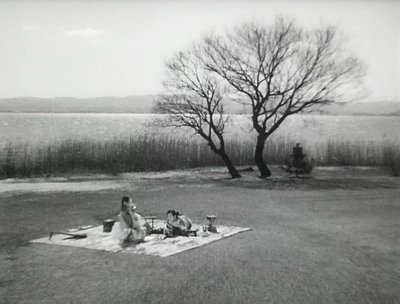

Whew! That was a mouthful. Hoepfully that all made sense to everybody. Really, for such a short movie, there really is a lot going on here and I'm surprised that Mizoguchi managed to keep all the goings on contained to ninety minutes and change. I actually barely scratched the surface there, as the four main characters actually take separate paths and we get to see what becomes of each of them. Although, I guess if you're reading past the spoiler tag, you already know that. I suppose I liked this well enough, but at this point movies that are scoring sixes and sevens aren't cutting the mustard. In the past two months, I've only given out two scores of an eight or higher for BOOK movies and only one ten all year, to a BOOK movie ("Scarface"). Sure, I may just be getting to picky for my britches, but it seems that my goal to save nothing but greatness for the final 100 was unsuccessful. Instead, I've loaded the final 100 with heaps of mediocrity and Ugetsu falls into that category. I'm usually not one for fantastical elements in my films, but I suppose it worked here to mild success. I dug the few twists that were strategically placed throughout the film - one where we learn that Lady Wakasa is actually a spirit and the other when we learn that Miyagi is dead.


Perhaps one of the saddest moments I can remember in recent memory to come out of a BOOK movie was the revelation that Miyagi was deceased. When Genjuro finally makes his way back to his family, it's a sweet moment. She tells him she doesn't care where he's been, only that he's safe and he seems genuinely happy to see her again. Not only has he just had an affair, but he learns that his mistress was a ghost. He's scared & confused and it's Miyagi who puts him at ease. Only for us to learn the next morning, that Miyagi has been dead and that Genjuro's dreams of her were only a wish filled dream. Call it good, but not great and probably ripe to be rewatched someday and reconsidered.

RATING: 6/10  I was gonna' go '6.5', but I liked Walkabout a little better and I only gave that a '6' too, so thems the breaks.

MOVIES WATCHED: 985
MOVIES LEFT TO WATCH: 16

October 21, 2015  3:26pm

Wednesday, September 23, 2015

282. Sansho Dayu/Sansho the Bailiff (1954)


Running Time: 124 minutes
Directed By: Kenji Mizoguchi
Written By: Yahiro Fuji, Ogai Mori, Yoshikata Yoda, from story by Ogai Mori
Main Cast: Kinuyo Tanaka, Kyoko Kagawa, Eitaro Shindo, Yoshiaki Hanayagi, Ichiro Sugai

So my vacation starts tomorrow and while it would be the perfect opportunity to polish off a whole crop of BOOK films, I don't actually have plans to. My wife and I are going to take the week to get some much need R&R and watch some "fun movies" as opposed to me spending the week catching up on my personal project. If I can, I'll sneak one or two, but don't expect much out of me for the next six days. Anyway, the season premiere of Survivor meant my wife was off limits for ninety minutes, which freed me up some time to knock out another two plus hour BOOK flick. Read on...


The film's plot is pretty cut & dry, not to mention pretty basic and uninteresting. When their father (and husband) is banished from a community, two children and their mother must fend for themselves, departing to live with her brother. Years later, the trio set out to fend for themselves once more, setting up camp, lost & alone. They are happened upon one evening by a priestess who is most kind, offering them a warm place to stay for the night and a hot meal. Once she hears of their situation, the priestess offers to introduce mother & kids to some boatmen, who will take them to safety. The next morning, once mother enters the boat, the boatmen and priestess are revealed to be tricking her, keeping the kids behind, as their mother sails off. The kids, Zushio and Anju, are then sold into a slave labor camp, headed up by the title character - Sansho the Bailiff. The kids are worked nearly to death and live as slaves until they are teenagers - the female, Anju, always wondering what became of her mother and her brother, Zushio, becoming a loyal, expressionless henchmen for the ruler Sansho. One day, while taking a dying woman to the mountainside, so that she can pass in peace, Anju convinces Zushio to flee, stating that she will stay behind and lead the guards in the wrong direction. Zushio knows that his sister will be tortured until she gives up his location, but does as his sister wishes. Anju stays behind in hopes that her brother will successfully flee and find their long lost mother.

SPOILER ALERT!


Pardon me if this review stinks, but my attention is currently being divided between the blog and the Big Brother finale. I'll do my best to keep my thoughts in order...

Boy, I didn't like this very much at all. Sure, it's possible that my mind was elsewhere - thinking of getting through my last day of work tomorrow and getting to that much needed vacation. However, my mind knows when a good movie is playing out in front of it and will sit up and take notice, if need be. This just wasn't a movie that grabbed my attention and therefore, my mind wandered and I was rather bored throughout. The film just didn't strike me as anything unique or even worth me wasting my undivided attention. The characters were rather bland and at no point during the two hour running time did I begin to fall for them, caring about how they ended up, rooting for their success, etc. Instead, this whole film felt like something I'd already seen before - perhaps from the likes of Kurosawa or some other sad sap. Kids separated from mother, son rises from slave to ruler and an ending that was both happy & heartbreaking. Nothing about this felt unique to me and while it may have been unique in 1954, it didn't pass the test in 2015.

I guess I can't say it was all bad. We all know I'm a sucker for a sad ending and while the film did end on a bit of a high note, with Zushio reuniting with his mother, you got the sense that she was on her last legs and wouldn't have much life left, making his whole journey nearly fruitless - his sister dead, his mother nearly there. Also while it started out like something that was going to be confusing, it all cleared up pretty fast and unfolded as a plot that was very easy to follow, filled with layers and characters whose lives sprawled out, despite being fairly one dimensional. I wasn't ecstatic about the film, but it may have been a case of wrong film, wrong time. Like I said, my mind was indeed elsewhere and Sansho the Bailiff wasn't near powerful enough to demand my attention, capture my imagination and therefore, I'd have to call it non-recommendable.

RATING: 4/10  Call it a '4', as I wouldn't even go so far as to say it was average or anything worth going out of your way to see. However, BOOK hounds, don't fret, it's a fairly easy watch.

MOVIES WATCHED: 966
MOVIES LEFT TO WATCH: 35

September 23, 2015  10:54pm

Sunday, February 28, 2010

120. Zangiku monogatari/The Story of the Late Chrysanthemums (1939)

Running Time: 142 minutes
Directed By: Kenji Mizoguchi
Written By: Matsutaro Kawaguchi, Yoshikata Yoda, from novel by Shofu Muramatsu
Main Cast: Shotaro Hanayagi, Kakuko Mori

A FANTASTIC, JAPANESE LOVE STORY

I'll admit that I had my doubts about how this movie would strike me and while my knowledge of Asian cinema isn't that vast, this was a great picture to start adding to that knowledge. "The Story of the Late Chrysanthemums", was a really depressing, heartbreaking love story and it really hits the emotional button with extra force.

Kikunosuke is the son of the legendary Japanese actor named Kikugoro, and is also an actor himself, staging performances in the city of Tokyo. Kiku (his shortened name in the film) eventually comes to the realization, that while his fellow actors and even his father praise him behind his back, when he's not around they complain about how terrible he is. While Kiku suspects this, he is never given a straight answer by anyone, due to the fact that he is the son of Kikugoro. One evening, while riding home after a performance, Kiku runs into Otoku, his baby brother's nursemaid. Otoku tells him that she went to see one of his performances, and while being careful not to offend him, tells it to him straight...that he's just not that good. He praises her for her honesty and tells her that because someone finally laid out the truth to him, that he will use it as inspiration to get better. After Otoku's show of honesty, Kiku becomes very close with the nursemaid, eventhough the rest of the family frowns upon fraternizing with her. When the two are caught alone in the house together, eating watermelon nonchalantly, Otoku is fired.

In rebellion against Otoku being let go, Kiku leaves his father's home, vowing never to return unless Otoku is welcome. Eventually Kiku finds himself on a train to Osaka, and while he tried to take Otoku with him, the families of the two lovers stepped in and kept her from going. Kiku takes a job as an actor in Osaka, and realizes on his own that he hasn't improved, especially without the honest criticisms of Otoku. However, Otoku tracks down Kiku in Osaka and the two are reunited and happy as ever, despite living in squalor. Some time passes and the show that Kiku is working on in Osaka is shut down and Kiku is forced to take an acting job with a traveling troupe of actors. Four years pass and the couple are still together, living in even more poverty, with Otoku's health on the decline. Despite a few slight quarrels, the couple stick together through thick and thin. However, the traveling troupe of actors are soon shut down as well, and the couple are forced to take refuge in a shelter. In a last ditch effort to make everything right for Kiku, Otoku travels to see an old friend and beg him to get Kiku a job in a role in a big stage play that is being put on. If Kiku can impress the audience, then he'll get the chance to return to Tokyo and become a world renowned actor. However, if Kiku does return to Tokyo, Otoku must take a vow to let him go alone, so that he may reconcile his differences with his father.

This movie is really a downer and it's ironic that this great cinematic love story is being played out in such a depressing film. The love that Kiku and Otoku share for one another is a beautiful thing and really highlighted by Mizoguchi. However, every time the couple seem to catch a break, it always ends badly and they find themselves right back at square one. Even the climax is a heartbreaking one and despite all of the sadness that this movie contains, it's still a really beautiful film, both visually and emotionally. I've always loved the setting of the orient in films, as I feel that it's a really photogenic country, that usually seems to give off some fantastic shots and wonderful backdrops. The Japanese culture is always one that I've felt that I could really fit into and having a film set there, really appeals to me. Anyway, I'm getting off on a rant here, but "The Story of the Late Chrysanthemums", despite its depressing tone, is still an enjoyable picture and something that I would really recommend to anyone.

RATING: 7.5/10 That's another rating that I could definitely see climbing as time passes, and don't be surprised if this shows up on the next "TOP" list, with a higher, revised rating.

NEXT UP: Babes in Arms...A Busby Berkeley musical...sounds allright to me. I'll be getting to this one, and the film that follows this one tomorrow, so be on the lookout boys and girls.

February 28, 2010 2:13am


Sins of Omission - Entry #94: ZODIAC (2007)

Running Time: 157 minutes Directed By: David Fincher  Written By: James Vanderbilt, based on the book by Robert Graysmith Main Cast : Jake...